Stutz
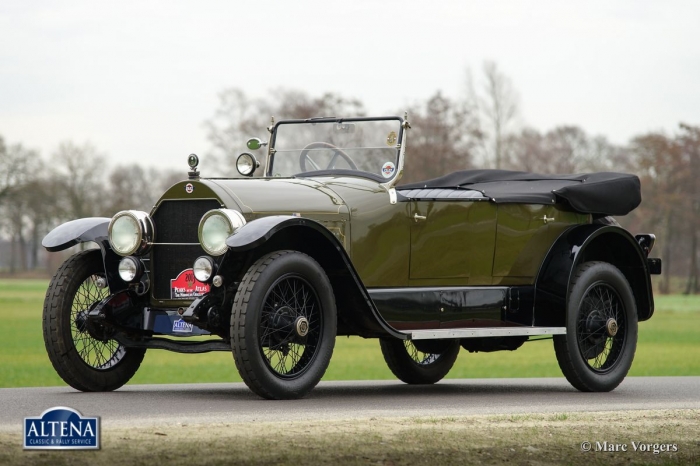
Series K DH Open Tourer, 1921
- 1921
- Sold
The Stutz Motor Company was founded in 1911 by Harry Clayton Stutz and existed until 1935. To gain name recognition, Stutz entered a car in the 1911 Indianapolis 500. This car, a straight-out-of-production car with no modifications, finished 11th in the race, earning it the slogan "The car that was made right in a day." Throughout its history, Stutz became known as a manufacturer of fast cars (America's first sports car) and luxury cars for the rich and famous, comparable to Cadillac, Packard, or Pierce-Arrow.
Stutz's most famous model was the Stutz Bearcat, a high-performance Roadstar with a 4-cylinder T-head engine with 4 valves per cylinder, one of the first multi-cylinder engines. In 1928, the French coachbuilder Weyman entered a Stutz in the 24 Hours of Le Mans. This car, in the hands of Robert Bloch and Edouard Brisson, led the race until 90 minutes before the checkered flag, when it unfortunately lost top gear and finished second, behind Bentley. Another famous model was the Stutz DV32, which appeared in 1931. This model was powered by an inline 8-cylinder engine with 4 valves per cylinder and double overhead camshafts.
Sales information:
This Stutz K DH Open Tourer was extensively restored in Sweden around 1980, then ended up in a collection and was hardly used until its Dutch owner acquired it in 2011. The car was built in 1921 and is equipped with a 4-cylinder engine of 361 cubic inches (5,9 liters) and, very unusual for that time: with 4 valves per cylinder, dual ignition, and a transaxle system (gearbox together with a differential on the rear axle).
The smooth engine delivers 80 hp at 2400 rpm and is coupled to a 3-speed gearbox.
The "DH" in the model designation stands for "Drop Head," which didn't refer to the soft top but to the engine, as this was the first model with a removable cylinder head. It was also the last model with right-hand drive. The engine runs excellently and has plenty of torque, and is fitted with a Stromberg carburetor.
The brakes are mechanical on the rear wheels. A significant improvement was the replacement of the original pressed steel brake drums with cast iron ones. Maintenance has been excellent. Among the replacements were: radiator, wiring, differential, gearbox gears, driveshaft universal joint, and better-functioning cast iron brake drums, a 6-volt electric fuel pump (the original fuel pressure system is still present), and auxiliary lights at the front.
The fact that the brakes have improved significantly was also evident during the Peaks of the Atlas 2013, a 2500 km tour in Morocco.
This Stutz was also the winner of the 100 Miles of Amsterdam in 2012 and also completed a number of rallies and tours.
Since August 2011, it has been driven approximately 6500 miles without any problems.
The strength of this unique car (practically impossible to find in Europe) is that it's completely original and has been restored with meticulous attention to detail. Not over-restored, as we so often see, but with everything beautifully balanced.
A truly unique car that can give the pre-war enthusiast a lot of pleasure!